Table of Contents
The SEO company in Dubai can help businesses shape website content around the different ways customers search, compare, evaluate and act. Instead of treating every visitor as someone ready to make an inquiry, businesses can create content that responds to the information people need at different points in their decision-making process.
A visitor looking for basic information has different expectations from someone comparing service options. Recognizing this difference helps businesses organize their websites around genuine customer needs and create a clearer path from the first search to a potential enquiry.
SEO Company: Understanding Different Search Journeys
Discovery journeys
The discovery stage often begins with a question, problem or area of interest. Visitors may not yet understand the available solutions, so content should introduce the subject clearly and provide useful background information without immediately becoming promotional.
Comparison journeys
Once visitors understand their requirements, they may begin comparing approaches, features, service models or possible solutions. Content at this stage should explain meaningful differences and highlight the factors that could influence a decision.
Evaluation journeys
Evaluation takes place when a visitor has narrowed down their options and wants more evidence before proceeding. Detailed service information, examples of previous work, processes and practical considerations can answer the questions that arise before an enquiry.
Action-oriented journeys
At the action stage, the visitor is usually looking for a clear way to proceed. A well-structured service page can explain the offering, clarify the next step and make enquiry options easy to find without adding unnecessary information.
Matching content to search purpose
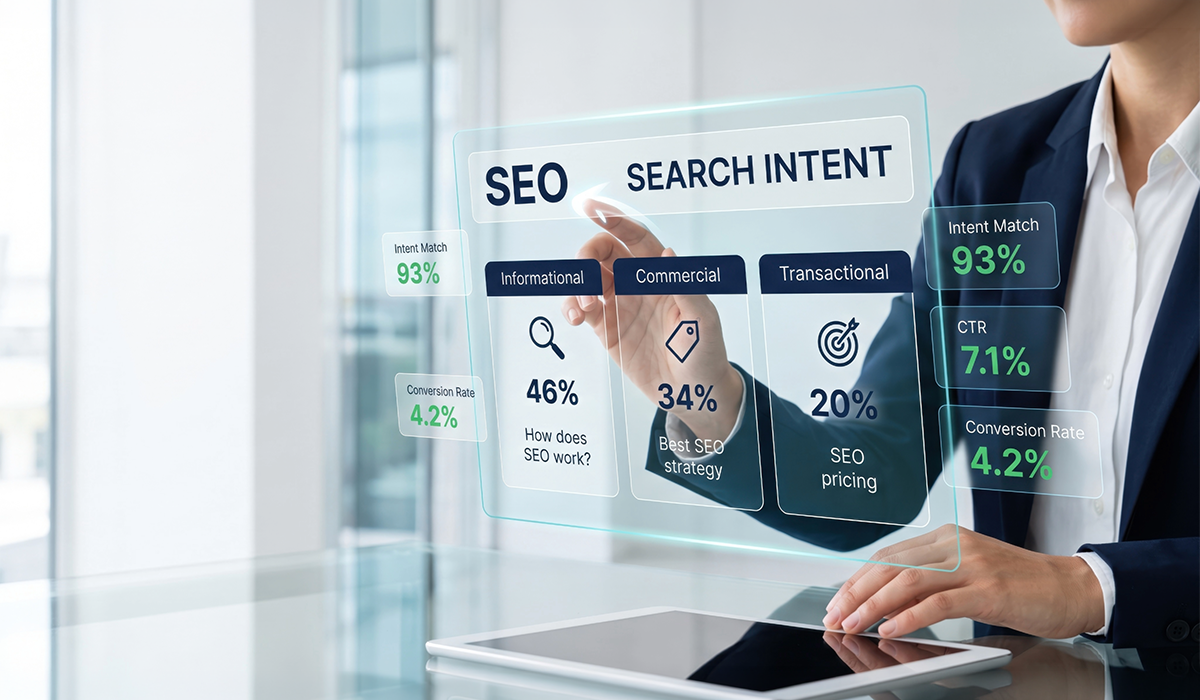
A search intent SEO approach starts by understanding why someone has made a particular search and what type of information would satisfy that need. Businesses can group searches according to discovery, comparison, evaluation or action-oriented purposes and assign each page a clear role.
Using different content formats
Different stages can benefit from different formats because visitors do not always consume information in the same way. An explanatory article may suit early research, while a comparison guide or case study can provide more useful information to someone evaluating available options.
- Explainer articles for introductory questions
- Comparison guides for evaluating alternatives
- Case studies for practical examples
- Service pages for solution-focused searches
- FAQs for specific concerns
Strengthening existing pages
Businesses do not always need to publish another article to address a content gap. An existing page may already attract relevant visitors but lack an important explanation, supporting detail or useful connection to another resource. Content optimization can improve the page while preserving its original purpose.
SEO Company in Dubai: Methods for Optimizing Content Across the Journey
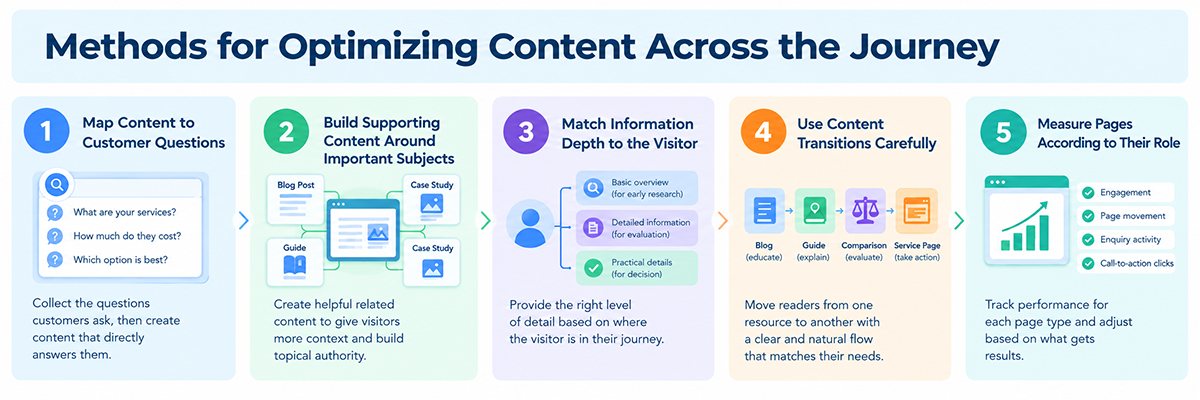
Method 1: Map content to customer questions
A useful starting point is to collect the questions customers ask before, during and after considering a service. These questions can then be grouped according to the type of information they require, helping businesses decide whether they need an educational article, comparison resource, service page or another format.
This gives SEO companies a practical framework for developing content around real information needs rather than producing separate articles simply because related search terms exist.
Method 2: Build supporting content around important subjects
A major service page does not need to answer every possible question itself. Supporting articles can address specific subjects in greater depth and provide useful context for readers who need more information.
This approach also keeps commercial pages focused. Instead of adding lengthy explanations that may distract from the main service, businesses can use supporting resources to cover related subjects in their appropriate context.
Method 3: Match information depth to the visitor
The amount of information required can change considerably between search stages. Someone exploring a problem may need a straightforward explanation, while a visitor evaluating a service may want information about deliverables, processes, timescales or practical requirements.
An effective SEO content strategy therefore considers not only the subject being covered but also the level of detail that is useful to the intended reader.
Method 4: Use content transitions carefully
Moving a reader from one resource to another should feel relevant rather than forced. An introductory article might lead to a detailed guide, while a comparison resource could direct readers towards a service page when they need more specific information.
Useful transitions can include:
- Related guides placed where they add context
- Relevant service links within supporting articles
- Clear next-step information on detailed pages
- Contextual links between closely related subjects
Method 5: Measure pages according to their role
Not every page should be judged by the same outcome. An educational article may be useful for attracting and informing new visitors, while a commercial page may receive fewer visits but contribute more directly to enquiries.
Businesses can review different signals according to each page’s purpose:
- Engagement with educational resources
- Movement between related pages
- Enquiry activity from commercial pages
- Interaction with important calls to action
This provides a more useful picture of how individual pages contribute to the website as a whole.
Applying Search Journey Optimization to Service Businesses
Structuring Content for Service Businesses
Service businesses often have longer decision processes because customers may need to understand their requirements before selecting a provider. SEO services in Dubai can support this structure by developing separate resources for initial research, detailed evaluation and service-specific questions.
For example, an educational article might explain a common customer concern, while a separate service page could address the solution in greater detail. Each resource can then serve its own purpose without forcing every subject into one general page.
Creating content for informed audiences
Not every visitor begins with a basic question. Some already understand the subject and search for specific information such as implementation details, service differences, technical considerations or expected deliverables.
SEO services can support this audience through focused resources that move beyond introductory explanations. Detailed guides, practical examples and specific service information can provide greater value when the reader already has a defined requirement.

What Businesses Should Review Before Creating New Content
Start with real customer questions
Customer conversations can reveal information needs that may not be obvious from search data alone. Sales teams, support staff and account managers often hear recurring questions that can become useful subjects for website content.
Give every page a defined role
Before publishing a new resource, companies need to determine what purpose the page needs to serve. A user looking for “best SEO agency” will be considering a number of options, and the page will have to provide useful data in relation to that consideration.
Keep the journey connected
Content should work as a connected system rather than a collection of unrelated articles. Visitors should be able to move from an introductory explanation to a more detailed resource when they need additional information, without encountering the same points repeatedly.
Conclusion
A search journey can involve several information needs before a visitor decides to enquire. The SEO company in Dubai can help businesses structure content so that educational, comparative, evaluative and commercial pages each have a specific function.
For businesses, this method can make website content more functional without adding unnecessary explanatory or persuasive information. A properly organized structure enables each page to make a distinct contribution to the overall search journey.
Businesses can review existing articles, service pages and supporting resources to identify missing information and unnecessary overlaps. SEO consultants can use these findings to develop a more connected content structure based on actual customer needs.
SEO can support the planning and refinement of search-focused website content. Regular reviews can help keep individual pages relevant while reducing unnecessary duplication across the website.
SEO companies can also help businesses refine this structure as customer questions change. Reviewing content periodically allows new information to be addressed without repeatedly creating pages that cover the same subject.
For businesses looking to structure content around different search journeys, Circle Out provides SEO support focused on creating relevant and purposeful website content.
Frequently Asked Questions
How can a business identify different search journeys?
Companies can study customers’ questions, enquiry patterns and the information visitors seek before reaching a decision. These insights can then be grouped according to the type of information required.
Why should every website page have a specific purpose?
A defined purpose helps prevent different pages from covering the same subject in similar ways. It also makes it easier to decide what information belongs on each page and how that page should contribute to the website.
Can existing website content be adapted for different search stages?
Pages can be improved by reorganizing information, adding useful details or linking to other relevant pages.